
"The Never Not Yes" by Jonathan Epps - A Review

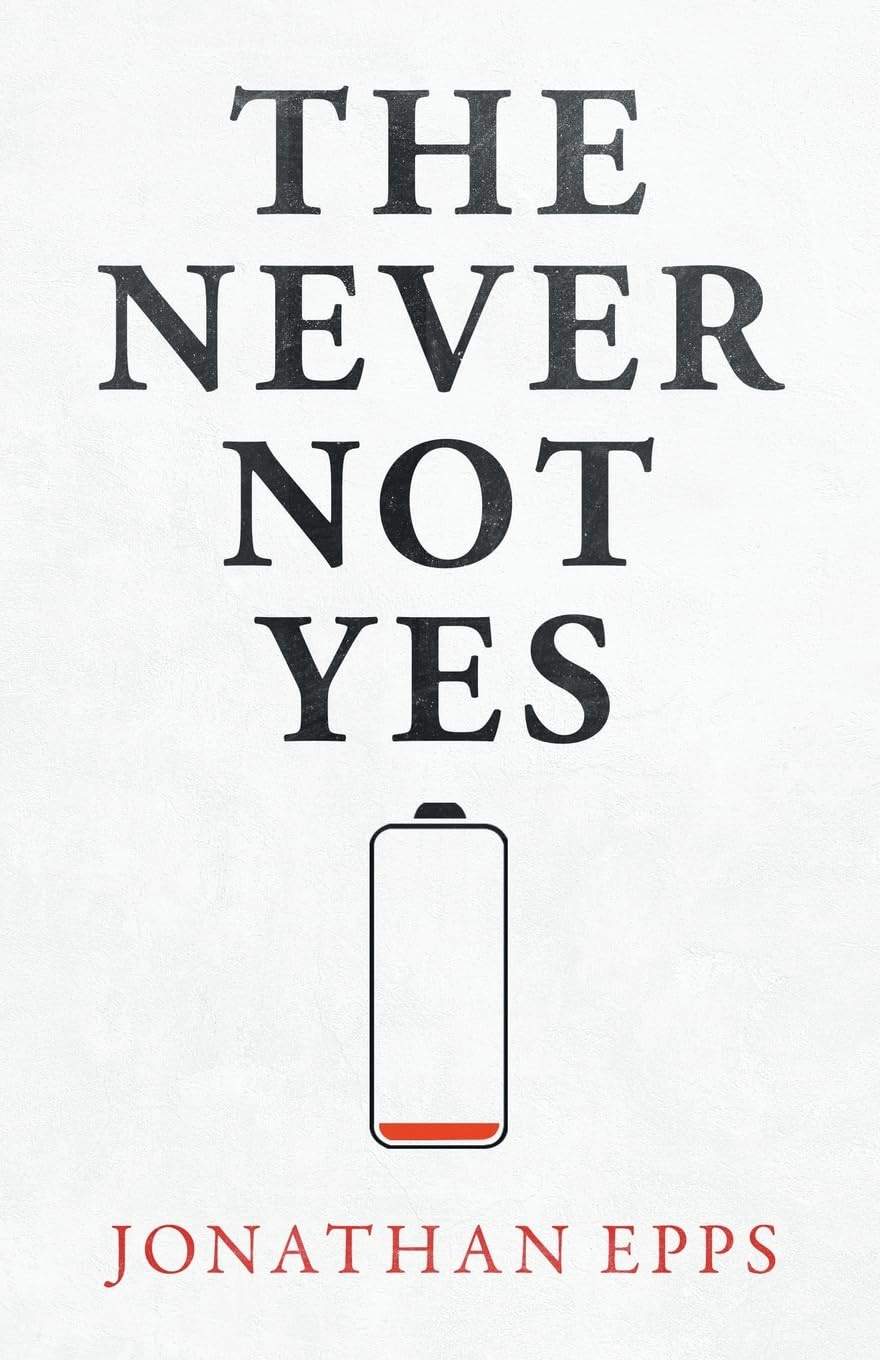
The Never Not Yes is a dystopic novel of America. The action of the novel sprawls over the once-mythic landscape now descended into desperation and violence. We follow three main groups of survivors in the southeast as they strike out after the final collapse of the power grid. Ant and Mina set off from North Carolina for the promise of Texas, rumored to still be functional even as the rest of the country falls into chaos. Jeremy and Jenna and their friends, Pru and Nelson, escape the violence of the Atlanta suburbs. Then we have Roland and Charlie, a couple from Miami fleeing to safety before Roland succumbs to complications from AIDS. Each group has its own adventures before coming together, prepared to forge a new life, rid of the old America and its grievances.
The individual narratives and arcs are entertaining and characters likeable, but it’s marred by an abstract language built for argumentation, not the sharp sensory detail of the novel form; and socio-political commentary that is both heavy-handed and vague. The text, more than a few times, lectures us about the fallen culture that led to this. But vagaries in worldbuilding prevent us from truly understanding the characters’ perspectives and the novel’s import for our own times--one comes away with the amorphous notion that it’s all the Left’s fault, who are just like the white supremacists, who are nothing like the muscular and masculine conservatives the novel wants to put forward. But even that is ultimately undone by its own nihilism.
The Leviathan has no clothes: worldbuilding and character
One test for any novel is whether it presents a plausible reality. This is a question that always sticks out with dystopias and post-apocalypses and there are many ways for an author to dance around this. The zombie apocalypse, for instance, is evergreen all the way back to medieval fears of the miasma. The modern reader/viewer doesn’t need to question it too hard because it’s simply a vehicle for human drama and social commentary. The undead might be a myth, but being cannibalized is a deep-seated fear and entirely plausible. It’s hardly an imminent threat for most of us but not without historical precedent. The compounding of primordial dread and relative imminence overcome any objections to the suspension of disbelief.
But a political apocalypse is another matter and that is what Epps presents in The Never Not Yes. It’s a slow-walking apocalypse, a true dystopia as political order breaks down and material conditions follow. There is a lot of fruitful ground here for the dystopic author, and Epps is aware (Ant’s family name: Hobbes), but he fails to capitalize on it in a coherent manner.
The year is... sometime in the 2030s. Unclear but also not strictly necessary. There’s a “sectarian” war of racists and partisans. Unclear. It seems urban factions have largely formed around ethnic and racial identities because Americans have been so thoroughly baited into racism and distrust that we all accept such violence readily--a central conceit common to many dystopias (though not often so racialized) and which I generally accept without ever actually believing as long as the story doesn’t devolve to taking sides. There was a pandemic? Unclear its import. There was a ground war in Taiwan--Jeremy fought there. The power grid has collapsed because... Hollywood, or NYC HR Departments... unclear. The Progressives? Unclear, but probably, and it seems to lump them in with the white supremacists (I’m fine with that argument, I guess, if that’s really the argument of the story and not just the exposition). This is one of the central problems of the text: vague worldbuilding built on the grievances of 2026 with no causal chain to take us into the future.
We have an outline of the facts and more beside scattered throughout, but it rarely amounts to a cohesive narrative of events or I simply couldn’t be bothered to pay enough attention if it did. I was not gripped except by action. However, this can all work, such as in Civil War. But in that movie, there’s a hard focus on character apart from the larger issues of the war and civil breakdown--the war could be about anything, these journalists would still be doing the same thing and the arc would be the same--all those foreign battlefields come home collapsing into one spatially-bound narrative the characters move through.
Not so here, the narrative constantly reminds us and the characters opine that this is all the result of a decadent and racialized culture. Dialogue and exposition both evince a politics born and raised in an echo chamber that can’t recognize its missing ligaments and connective tissues, barely articulate--the only grounding the reader really has is the discursive milieu of our own times and then has to spend a lot of energy situating themselves in relation to the text’s own ideological idiosyncrasies--it would be genuinely unfair to label this as reactionary rightwing lit, but you couldn’t be blamed for thinking so. It just may well be, but it’s definitely not the Turner Diaries and, at least consciously, rejects overtly racist politics. I leave it to individual readers to determine for themselves.
What is certain is that without a clear delineation of the facts and factions and causal links that take us from our own fraught era in the real world to this fictional collapse, when characters wax despairing of their fallen world and where the blame lies, we can’t really evaluate their statements or them as characters.
For instance, we’re told Texas has a functioning power grid, which, irl 2026, begs the question “when and how?” No explanation, just some wishful thinking about how Texans finally remembered they wanted to be their own nation and suddenly they all got it together--I guess the republican government stopped disenfranchising people; or it finally accomplished its ethnic cleansing; or its elites opted for largesse instead of extraction. Unclear. Just accept it, that this is the way the world was/is in 2026.
Spoilers beyond:
We never make it to Texas, so we never know if any of this is true. The world remains a small echo chamber carried on the backs of its characters.
This has the effect of making characters’ insights seem like the mushy missives of online cranks, and motivations purely reactionary to contrived plot points. No matter what you think of the politics themselves, it’s not satisfying narratively because it hollows the characters out and replaces them with discourse. There are plot goals, but they rarely have strong motivation, and without strong motivation there can be no strong arcs. His viral load about to explode, Roland and Charlie venture into a city looking for gas which spirals into Roland leading a coup against a gay warlord. I have no clue Roland’s motivation other than a general overbearing need for dominance and, if I think hard about it, he hasn’t fully accepted the new world. But this never quite amounts to a proper arc, I don’t think. Maybe I missed it in the squishy prose.
(There is some fun to this, though, just look at that set-up: gay man dying of AIDS leads a coup against a gay warlord. This seems inherently campy and Epps seems to understand this, but just doesn’t have the skill to carry it off effectively. There are similar moments throughout--the story is not without some levity. Also, the text’s relationship to its gay characters is a whole thing my gay ass does not feel like unpackaging here).
As such, these people are listless and that doesn’t seem an aspect of character so much as an aimless and-then plotting. Texas is quickly forgotten even before the group comes together, then the group comes together and begins making a home where they are, until a war wipes that out and sends them fleeing, the end. Eventually, I just bracketed the characters’ opinions, stopped trying to wrestle with the incomplete arguments and motivations, and started reading purely for action. My enjoyment went up considerably for a time.
The characters have been emptied and filled with discourse, and their relationships constantly mitigated by identity politics, racial and ideological. When Ant remarks on his schooling in the before-times, “It was obvious no one knew what the hell was up about anything. Total ignorance” we have next to no in-world context for this. It’s the kind of statement designed for those who would identify with him personally to nod their heads sympathetically because they know who he’s talking about--those people, the “no ones.” Indeed, this is how it goes in scene: Jeremy nods knowingly, and their bond is cemented.
The text loves identity politics, but seems embarrassed by having quietly taken a side and insists on dragging its diverse characters into the most surface level identities, such as when Ant (a young, rural black conservative/libertarian) and Jeremy (Hawaiian, ex-military) recognize each other as non-whites in a torturous scene. “The warmness in Jeremy’s voice might have felt awkward for their race differences, their maleness and manhood, their relative ages, but these beings had been shucked of their casings, as raw and exposed humans to the elements of humankind; and, however riskier, men of goodwill were freer to be natural actors in the world.” A better social commentator, the kind who loves picking this stuff to the bone (a proper Leftist, if you will) would make hay with this. I just find it silly and unserious, or possibly worse.
Dolores, arguably the vilest character here, has been clearly identified with New York, has dyed hair, and worse, they suspect her of being a Human Resources Director. The other vile murderer, was an actor from Hollywood, which came as a massive surprise after a side character gave a long diatribe about actors and Hollywood and their part in our destruction (not long enough to explain how Hollywood did this, but enough for the narrative to justify the statement by having a clown serial kill the speaker and his wife and write “hurray for Hollywood” in blood. At least there was an effect on the plot--it got Mina back on the road.
Sometimes, it feels like the cast is diverse so Epps can lecture minorities from the safety of a different skin. The whole issue of black respectability politics turns up when Devonte, another black man, arrives. He’s from NYC and never learned to code-switch. He speaks in straight hood, painfully and painstakingly transcribed for us. He’s rude without cause, and good boy Ant just can’t abide being called “n-ga” so there’s conflict. The scene, however, adds nothing to that debate for black folk. And worse, Devonte, despite occasional glimmers, never rises above or deepens that hood persona, he’s right there in the nihilistic climax tussling among the racists.
I’m not one to tell authors they can’t write outside of their own narrowly proscribed identity--that’s stupid and a sure path to cultural stagnation, but I do suggest caution. I can’t say that the insights are particularly wrong. “Jeremy shut his eyes in pain of the tortured humiliations to which some white people would stoop to seem cool by adopting something, they knew not what, the depth, pain, danger and belonging to which, they couldn’t possibly understand” and then he overhears a conversation at a party of white people complaining about the woke “mind virus.” Seen through Jeremy’s eyes, a Hawaiian cognizant of his history, the text doesn’t hide its disapproval. Racists are on Epps’ chopping block too, thank God. But it amounts to absolutely nothing, and this is the ultimate narrative sin.
Maybe don’t kill the dog: nihilism is always an unsatisfying read
I have no qualms about spoiling this for you by way of trigger warning, which I detest: the dog dies in scene. Dolores flays Jeremy and Jenna’s dog, Mullet, right there in front of us, with yelping. Dolores shows up in the third quarter, the matriarch of a group from New York, including her husband and son and Devonte, her lover. She has a strong intro. Within a page, we (because she’s bossy) and the characters (because she’s probably an HR Director) have decided she is horrible and will need to go. There was absolutely no reason to kill the dog and show us.
It is true that this incident is not entirely without cause or consequence, but I would suggest that the consequence is hardly enough to justify showing us the cruel torture of an animal and writers should be wary before going down this road. Not merely a professional faux pas, like it or not, it reflects on you personally as the one who wrote it. Welcome to 2026.
We already hated her, we didn’t need such a strong character statement to affect the following narrative shift. Epps would’ve done better to have Dolores murder a main character, such as Roland over there dying and taking up resources. Moreover, justice is immediate. Jenna discovers the scene and shoves her off a cliff, but, in what is a problematically hilarious twist, she’s saved from death by her fat; and the narrative decides it’s going all in, however briefly, on forgiveness, restorative justice, and found family--the following interlude is a white, blue-haired progressive’s D&D campaign. I’m somewhat glad I kept on reading because the narrative managed to stumble into unexpected places and my ire was somewhat assuaged. Not because I particularly care about the twee aspects of wholesome team-building, but because it was such a shift. The end, however, proved a whopping pile of nihilistic dogshit… dogless shit.
Here’s the problem and I’m going to be very blunt: there already wasn’t enough in this novel to hang on to. It didn’t pass my first page test; the style was frustrating; the plot--kinda fun; but the characters, stand-ins. So, when an already-hateful character kills a dog, and the author insists on showing us, what are we to think about this author and their work?
So I can only conclude that the author killed the dog because it did not matter to him, but he knew it would matter to readers; or thought he was offering enough, or the message was sufficiently deep, to counter or merit such an extreme plot point. Not for me. But I wouldn’t have gotten that far to begin with.
Meanwhile, (mild spoilers) The Boys gave Terror, the humpy bulldog, a peaceful ending. In that case, the writers understood what the dog meant to people, and they know it’s a narrative tool not easily bent toward contrivance or cynicism because at the end of the day, despite all the gore and evil and moral failure, The Boys is not nihilistic. Nihilism and despair are presented as states to be dealt with or features of the world to be pushed through; not wallowed in, which, in the end, is what this novel does.
Conclusion
The death of Terror triggers this flight into the dark night of the soul, and is therefore, in its final analysis, cathartic in both intent and affect within the narrative as well as within the viewer. It leads us to despair so as to guide us through it, and that should be our goal as writers however oblique, circuitous or horrific the paths we force our readers down. The death of Mullet gives no such comfort, because it leads to no such place.
Like Texas, any sense of hope will be quickly forgotten for the plot. The final act kicks off when a man shows up and tells us that Ant is being hunted from a previous incident on a plantation of a new confederate army led by a Judge Holden figure, as a northern army approaches.
There’s an early bit of exposition from Ant’s POV, which I took to be a central theme: “A Christian man, whatever his race, was once a figure worthy of imitation; now, the same type of man, even a black man, was vilified as equivalent to a white supremacist” who may or may not be “the most corrupted minority in American history” (unclear). The particular brand of rightwing grievance is christian conservative. But I would suggest that while there may be a christian perspective here, Jesus never shows, and it can’t escape its own nihilistic tendencies. There’s no legible redemption. The climax/denouement is an eschaton of racial violence, weakly redeemed by a heavenly vision, and then abruptly ends. It hardly suffices. Let’s hope Christ Himself does better in 2026.
Postscript
I didn’t even touch on gender roles here and probably more besides. Read this book if you’d like to have an internet argument and fight prose with little subtext and heaps of circuity. There is a part of me that, having actually gotten to the end, barely, I give it what I henceforth shall call a B-Movie Read Badge. Read this, but be warned what you’re getting into. If you can get some distance from the reactionary politics and don’t mind janky craft, then you can enjoy this for plot and the occasional insight. If there is such a thing as Bad Books Book Club, then this would be an excellent group read.
There is a vision here, one I might even have a lot of sympathy for. Glimmers to hang onto: He gestured to the men who surrounded him. “Mostly innocent men,” he said firmly. “So now, who am I?” he asked rhetorically. “What have I become?” He paused to smell for traces of death in the airstream. “I am an eater of men. I am the consumer of towns. I am the vacuum into which everything will go. I will finish by devouring the air.”
BD Allen lives and works in Georgia. He has been published in the Arcanist as the Hunger Flash Fiction winner, and several other publications.
Jonathan Epps has been writing fiction for roughly twenty years. He’s written six novels and a handful of short stories. The Never Not Yes is his fifth published book.
Lately, he’s taken serious issues from the culture and put them into visceral fiction. He believes American fiction has lost its edge, lost touch with many of the pressing issues of the period. He’s trying to revive engagement with the verisimilitude in fiction by creating the emotional necessity to reflect upon the troubles of the real world.
He’s an independent writer and partner publisher (thanks to Amazon), so he deeply appreciates any and all support from his readers.
Thanks for reading! If you are an author with a book you would like to have reviewed, or a reviewer who would like to review a book by a Substack author, or better yet, BOTH, you can learn more about how to get involved, by visiting:

Just a reminder to everyone who’s been enjoying The Substack Review — It is FREE and will always remain that way. However, it takes a lot of work. More than I had anticipated when I started it back at the beginning of the year. So if you’re at all able please become a paid subscriber or, if you’d rather, you can send a one-time donation in any amount to the TIP JAR below.
Thanks!

 | A guest post by
|
I snorted several times while reading this. Bravo.