
Review: John Kolchak's "The Eternal Return"
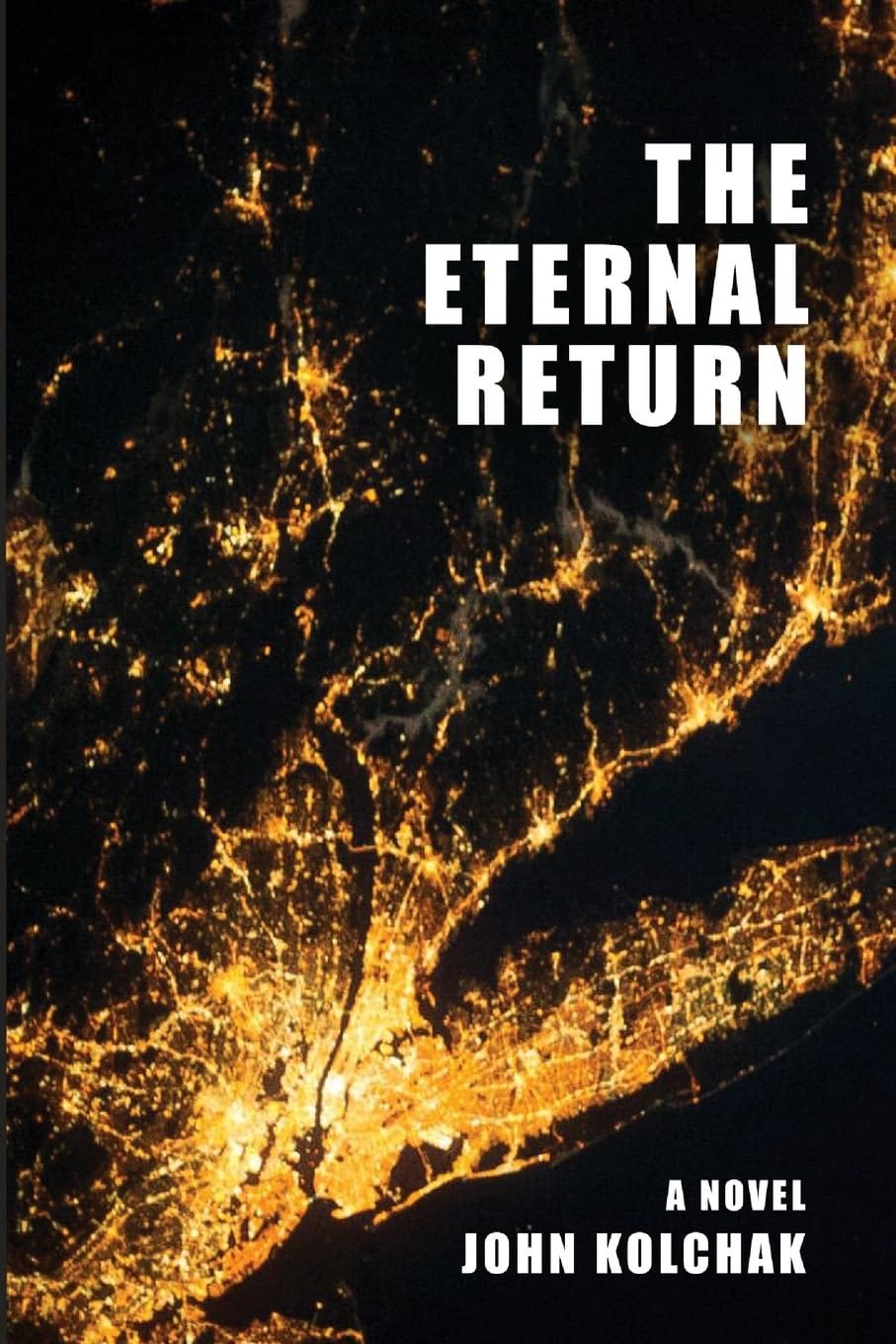
By Helen Grover
About half-way through John Kolchak’s The Eternal Return, the main character Lucky laments that all he has left are the “memories of an aging masturbator.” Memories of an Aging Masturbator would be a more descriptive title. Lucky is a bitter nihilistic pervert constantly interrupting the story of his doomed affair with a woman named Betty to ruminate on women who’ve wronged him, and into painful family memories, the meaninglessness of life, and his deep-seated sexual frustrations. It is the fatalistic doom-spiral of an old man obsessed with sex he can’t have, and it feels modern.
I struggle with how to classify The Eternal Return. Its nihilistic scattered structure warrants calling it an anti-novel in some respects, but the wrap-around nature of the plot, despite an ambiguous ending, makes me hesitate. It’s a Schrodinger’s plot, there and absent. A quarter of the way in I wondered if the narrator’s only goal was to get us to read his poetry and in some ways that ended up being true.
I wasn’t sure high-school Helen’s attempt to read Thus Spoke Zarathustra and the passages I’d read from Beyond Good and Evil were enough homework, but you don’t need any understanding of master and slave morality, resentment, or the will to power to understand this book. It reminds me more of Diary of an Oxygen Thief than Thus Spoke Zarathustra. Rather than cultivating will-power to overcome nihilism, this book focuses on neurotic internalized hedonism through masturbatory fantasy.
There’s a veneer of grossness to every sentence which I don’t mind as Nicole Cushing’s number one fan, but handling this type of prose is more difficult than writers usually consider. Someone like Barker or Ligotti disguises the grossness with psychic distance while someone like Cushing takes a more conceptual stance narrowing the grossness down into novel categories like “interesting” or presenting alternatives to grossness as “moronic hope.” I’d argue Kolchak is taking the latter approach here, focusing on women who were “born in a cemetery” and on the broader idea of “whoredom.” Unfortunately, the novel ruminated on these ideas without much commentary. The Eternal Return’s climax is ultimately about the nature of art rather than gender-relations or the meaning of life and while there is a connection between “whoredom” and its conclusions, I don’t think the level of misogyny I endured to reach the conclusion was worth the basic take that “writing someone’s story makes them a whore forever, and if you write your own story, you’re a whore for the rest of eternity.”
The Eternal Return overplays its grossness. My review is never based on my moral condemnation of a book. If it were, I’d review nothing but C.S. Lewis, G.K. Chesterton, and Joyce Meyer. I understand that a character isn’t the author and I won’t attempt to draw any conclusions about what Kolchak believes. That said, Lucky is a misogynistic hard r slinging racist full of self-pity and ironically enough considering the Nietzschean title, resentment. As soon as he realizes he’s lost one of the women he values for their mystery and promiscuity, he devalues her and attacks the men she leaves him for.
Blasé lusty prose conjures pesty but funny lines like “pedestrian delights of looking at a young woman’s ass” but can quickly veer into misogynistic tirades about Lucky’s love life “even the miserable bitch Mildred Rogers had some appeal on a hatefuck level, as did cute, stupid Candy, whose naivete reminded me of Brandy March.” While the book isn’t completely uncritical of Lucky’s misogyny, its criticism ultimately only surfaces through self-pity. Lucky assures us that he values his “true love” Betty for her intelligence, but the only “unintelligent” thing his ex-girlfriends seem to have done was date him in the first place. They did plenty of immoral things but nothing that makes them seem particularly stupid, especially next to a guy who seeks out women he considers whores and then gets angry when they have sex with other people. This may be dramatic irony, but I wasn’t satisfied with the payoff of that irony. The psychic distance and narrative framing held the novel back in this regard.
The chapter “Arbeit Macht Frei” serves as a microcosm of my issues with the novel. In addition to its melodramatic comparisons between the banality of modern work life and the Holocaust, this chapter contains almost everything I complain about and nothing I’m praising. Conversely, Glasha the Mole serves as the novel’s highpoint, capturing the essential themes of the novel through the creative telling of a fairytale. Glasha reflects the emotional struggle of not only Lucky but all of the women he flattens into “Stacy Fox” in order to tell his sordid stories.
Structurally the novel is ambitious. Lucky brings a disparate variety of ideas together, cities, people, the concept of the eternal return itself, Russian history, his family history, and more are introduced in passing but become their own self-contained elements over the course of the novel, all of them orbiting the story of Lucky’s relationship to Betty. You feel the vision, but so much of the novel is focused on sexual fantasy and pontificating about why Lucky is attracted to sexually available women that the impact is severely dulled. Lucky occasionally references long lists of people who mean nothing to us, and while he does contextualize them later, it can be nearly a hundred pages later.
Syntactically the novel ranges from solid to interesting but its diction and tendency toward inflammatory but not revelatory content keep it from reaching its potential. One issue with grossness is that it loses its edge if the angle isn’t consistently interesting. Lucky burns out on graveyard women and whoredom before the novel is even halfway through and while Kolchak’s vocabulary is expansive several lines suffer from thesaurus-syndrome.
Kolchak’s skill as a writer is undercut by a steady torrent of unsteady allusions and half-hearted slurs. Whether it’s working “fear and loathing” into a sentence because Lucky is in Las Vegas or talking about the “brave new world we’re heading toward” the best allusions hiccup, and the worst reference novels, films, and other media without sufficient context. Even when familiar with what was being referenced, the analogy being made could be hard to parse. This is somewhat in character for Lucky. He cares more about memory and mental experiences than anything else, but the strategy overstays its welcome. In terms of the use of racial and queer slurs, I don’t think that they added anything other than a degree of honesty about the fact some hateful people are in love with ugly words.
Substack reprobate Worst Boyfriend Ever said something stupid about typing the n-word out in his notes app before he starts writing a post “to remind himself he can say whatever he wants” as if this is something someone directly speaking their mind needs to do, and I think our narrator comes from a similar school of thought. The psychic distance and narrative framing are such that we see glimpses of a more nuanced worldview on Kolchak’s part but what exactly we’re supposed to glean from Lucky’s racism and LGBT-hate if anything remains occluded.
Given the popularity the late Pop Shit built on sexually repressed angry poetry rife with religious allusions, occasional outright hatred, and highly specific details, I think that this novel has an audience on Substack even if I’m not part of that audience.
Returning to the plot, Kolchak’s final plot twist is a trope that’s one of my least favorites in fiction, but I think it’s actually done interestingly here. It feels earned, and while I didn’t enjoy the novel, the ending helped me feel that I at least got something out of it. I just wish that it clicked thematically as well. Ultimately, I do not recommend this book. If it seems interesting despite the misogyny, or you want to verify anything I’ve said, give it a read. He’s posted it as a serial.
Helen Grover is a transgender writer from Kentucky. She enjoys reading and fencing. Her Substack is Evil Blog.
John Kolchak John Kolchak is a Russian-born American novelist, screenwriter and poet. He is the author of “Haymarket Square” - a novel-in-verse about post-Soviet Russia which made New York Times columnist and culture critic Cintra Wilson christen him as “one of a dying breed ... a thought criminal after your own heart.” He lives in Los Angeles.
Thanks for reading! If you are an author with a book you would like to have reviewed, or a reviewer who would like to review a book by a Substack author, or better yet, BOTH, you can learn more about how to get involved, by visiting:

NOTE ABOUT BECOMING A PAID SUBSCRIBER: In addition to contributing to the fund that will allow reviewers to start getting paid for their work, yearly paid subscribers will also get reviews of their books prioritized (limit two books per year).
"Bitter nihilistic pervert" is going on the dust jacket!
Bookjacket quote:
“I masturbated while reading this book. I masturbated when not reading it. Give it a try.” — Junk Man’s Son