
Review: Barbara Byar's "In the Desert"

Naked, Bestial
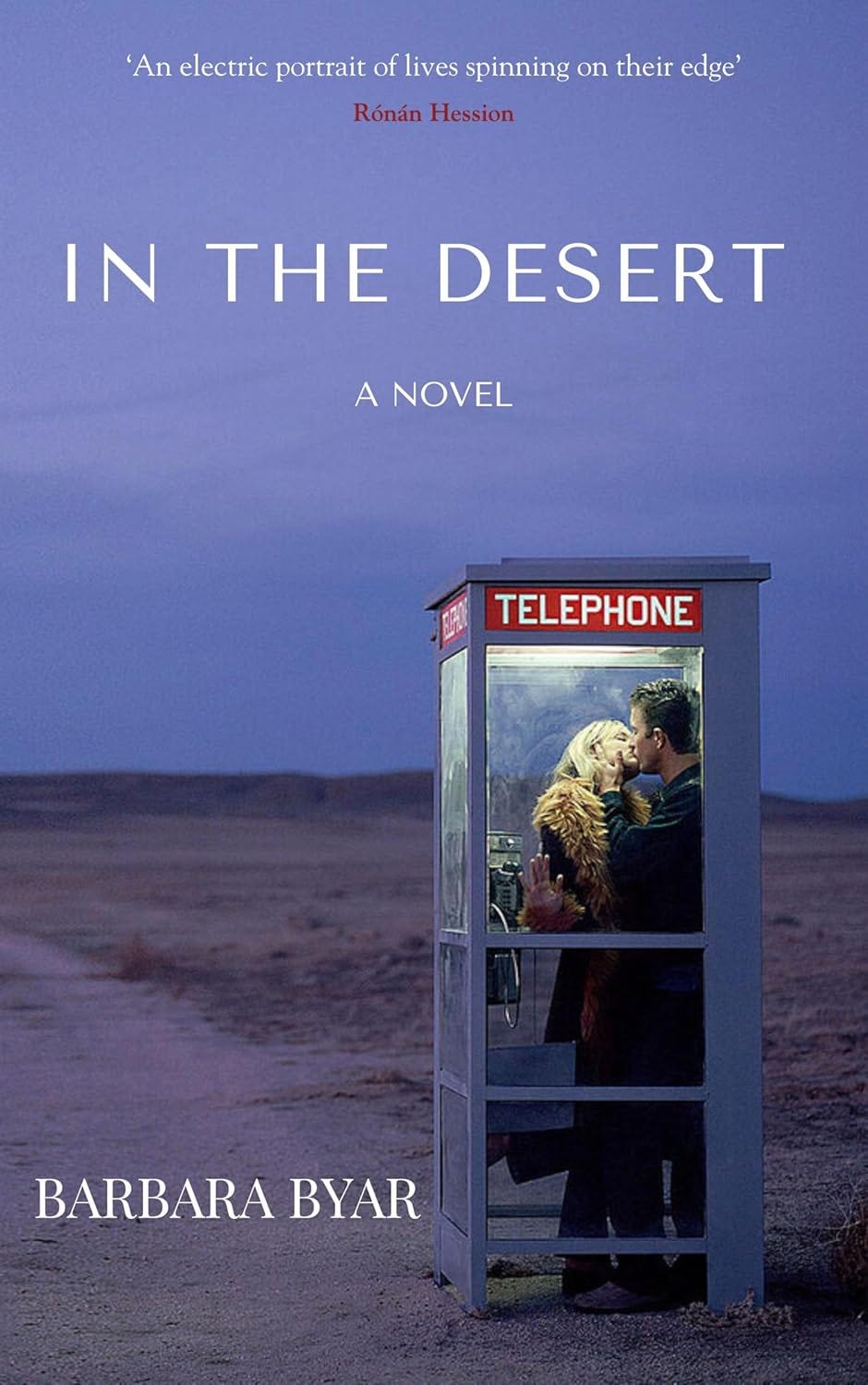
One should not judge a book by its cover but one inevitably does: on the cover of Barbara Byar’s debut novel In the Desert are a man and a woman in a telephone booth kissing passionately. The telephone booth is in the desert, which stretches out into the distance, out of frame, dry and vast, a vast nothing. The man and the woman are alone for what could be miles and miles and miles; the fluorescent glow of the telephone booth ensconces their love against the periwinkling dusk.
Yet if this image is striking in its minimalism, the novel itself is striking in its immense, operatic scope. Prostitution, murder, climate change, interdimensional travel, Hollywood, aliens, poverty, magic, immolation and incineration—all these, and more, are here. Byar is a faithful disciple of Horace, or at least his well-known exhortation to the storyteller to begin in media res: from the jump she fills our mind with questions. Who is “he”? Why is he running? From whom is he running? For whom is he looking? Who is “Jessie”? What is the relationship, exactly, between him (Raphael, we soon learn) and Jessie?
The beginning of the book may make you feel like you’re being spun by a desert tornado; all manner of plotbits and character scraps and odds and ends of worldbuilding detail are whirled around you as you are flung back and forth between past and present. Actually, the storm does not really relent later in the novel, either, but at least you feel better equipped to survive, if not withstand it. After some immersion in this whirlwind world, you can even piece together a pretty good outline: five friends, Raphael, Jessie, Travis, Sarah, and Alice, united by “a needle prick, a tower of hands, three shakes,” have grown up together in a small southwestern desert town— Nowheresville, USA. Raphael and Jessie are one young couple, Sarah and Travis another, and Alice is Jessie’s younger sister. Raphael dreams of achieving stellification via Tinseltown, which means his separation from Jessie, despite their love for one another. Jessie cannot follow, for she has her own dreams of becoming a singer and in the meantime must stay with her family and shoulder the burden of the family business. Travis and Sarah, too, cannot be: Travis comes from a wealthy ranching family, while Sarah wants to go to college, not sink into a domesticity she knows would be unfulfilling for her. Alice, the youngest, is a dreamer, and it’s she who leads them to a strange, hallucinatory carnival, then the fabled telephone booth.
The phone booth, reminiscent of Doctor Who’s TARDIS, is actually a “transporter”: it lends its user the power “to travel between dimensions, worlds, and times.” But if you think this will be some kind of heartwarming, whimsical tale of five besties going off on adventures through spacetime, think again. Many unwholesome things unfold. Characters are traumatized or inflict trauma. Their lives go from okay to bad to worse. They murder siblings, abort babies, lose their parents or friends or the use of their legs. Sometimes all this evil feels a little exaggerated, bucks belief. Both Raphael and Jessie end up prostituting themselves, one for stardom and silver screen success, the other for hard, cold cash. It’s true, Hollyweird has its horrors, and small-town life is not exactly lucrative, but when the pair reunite after trials and tribulations that drag them to hell and back, one wonders whether teen romance would really survive all that. Wouldn’t it be harder to attach, harder to trust? But the reunion is given little space to breathe, for Jessie and Raphael must defeat a soul-swallowing extraterrestrial named Raymond; the plot forges relentlessly ahead.
Plot-heavy novels are not inherently worse; the modernists lied to us. But in its harder-to buy aspects, its darkest, vilest moments, it seems the Demiurge of this universe (or these universes) subjects her fictional offspring to all manner of torture only for the sake of incident, excitement, spectacle, shock—plot imposed on character rather than originating from it. Travis, especially, becomes cartoonishly monstrous, more caricature than character. Alice is disabled and then re-abled, which makes you wonder what the point of disabling her was in the first place.
Stripped of its sci-fi and fantasy elements, In the Desert is reminiscent of westerns, road movies, Wim Wenders’ Paris, Texas. I loved this book best when it was rooted in the real world —those moments were more vivid to me than the fever-dream carnival or the intergalactic shadow man who cannot be shot. The ship graveyard, the desert itself, are images that haunt. Raphael’s long days of shooting his breakout film, having had his heart broken by his first love, having sold body and soul and the story of that first love to the vultures who hold sway over his advancement or annihilation in the film industry—the sad, strange, Faustian story of a dream achieved but at what cost?—and his heady amour with his co-star Chloé could be a perfect, self contained short story in itself. Dakota, the warm, wise, protective, intuitive aunt of Jessie and Alice, grounds Byar’s flights of fancy, her home literally an oasis in the desert. She meets, befriends, and falls in love with Hyun-Ki, a Korean astrophysicist who “happened upon her garden one autumn evening.” Their love is unexpected but lovely, tender in the way only love found later in life can be. And in spite of all the trauma-tarnish, the shine of Raphael and Jessie’s passion lingers, larger than the story scaffolded around it.
It isn’t that we want our tales to be earthbound and riskless, only that we want the risks to cohere a little more, mean a little more. We want “imaginary gardens,” yes, but we want them to foster and nourish “real toads.” When we soar off into the stratosphere, we want to be able to look down and see as a point of origin and return our home planet.
Yet whether the worlds created are real or imaginary, the words that create are real, and Byar wields hers with confidence. Her pen is practiced, deftly shunting us along, not allowing us to get distracted. The sharpness of the novel’s style can sometimes shatter into gratingly choppy fragments: “She tripped over tent posts. Teetered. Tottered. Nearly fell. Scrambled past dark caravans and glowing eyes. The fog thickened. Settled. Cold. So cold.” Attempts to infuse the narration with a character’s consciousness can feel forced when the character’s vital spark is dim. Sometimes, for the sake of a little literary flourish, phrasing becomes clunky: “…he’d make sure he put it to good riddance to bad trash use.” At one point it devolves to pop-music cliché: “…and they could have it all. It all… it all.” On the whole, however, Byar manages to land on her feet, no easy feat (pun not intended) in such a dust devil of a narrative. There are moments, too, of tender beauty, as when “moonlight glazes a milky cataract over dust and dirt, shrub and stones.”
Creative industries are becoming increasingly narrow, increasingly conventional, increasingly backwards-looking, increasingly anti-risk. The primary virtue of In the Desert is its sheer unpredictability. Looking at the cover, you guess at or imagine what this story will be. The first chapters shatter your first expectations as thoroughly as later chapters shatter your new expectations, and this goes on right up until the novel’s end. Byar’s blithe, blatant disregard for the strictures of genre is, to quote Joyce, “a fresh of breath air.” If her vision is rough around the edges, it is also deliciously raw. We need fearless writers now more than ever. We need writers who trust their readers. We need writers who can take their readers on a wild ride. Where is it, then, that the transporter of Barbara Byar’s imagination will next whisk us off to? This time we will refrain from guessing.
Ramya Yandava lives in Boston. Her poems and essays have previously appeared or are forthcoming in SOUVENIR Magazine, The Oxonian Review, and Bright Wall/Dark Room. She writes the newsletter Soul-Making at soulmaking.xyz.
Barbara Byar is a working-class American writer living in Ireland for over 25 years. Her critically acclaimed, collection of stories: Some Days Are Better Than Ours (Reflex Press) was short-listed for the Saboteur Awards. Her short fiction has been published and prize-listed widely, including Pushcart, Best Small Fictions and Best Microfictions nominations. She was shortlisted for the Irish Book Awards Irish Short Story of the Year in 2023 and longlisted in 2021. A recipient of an Irish Arts Council Literature Bursary and an Agility Award, she is Editor of MOTEL from Cowboy Jamboree Press. In the Desert is her debut novel.
Her writing can be found at https://substack.com/@barbarabyar and barbarabyar.wordpress.com
In the Desert can be purchased at the following:
Usa: Amazon.com or Bookshop.org
Uk: Amazon.co.uk
Irl: Amazon.ie or BuyTheBook.ie...
Or your local Amazon.
Thanks for reading! If you are an author with a book you would like to have reviewed, or a reviewer who would like to review a book by a Substack author, or better yet, BOTH, you can learn more about how to get involved, by visiting:
NOTE ABOUT BECOMING A PAID SUBSCRIBER: In addition to contributing to the fund that will allow reviewers to start getting paid for their work, yearly paid subscribers will also get reviews of their books prioritized (limit two books per year).
Or just make a one time donation—

 | A guest post by
|
Thanks so much, Ramya for this lovely and considered review of IN THE DESERT. Much appreciated!